Pool Deck Pavers in South Florida: Heat, Slip & Material Guide
A South Florida buyer's guide to pool deck pavers: how color drives barefoot heat, what wet slip ratings mean, how porous stone handles salt and chlorine, and why permits are city-specific.
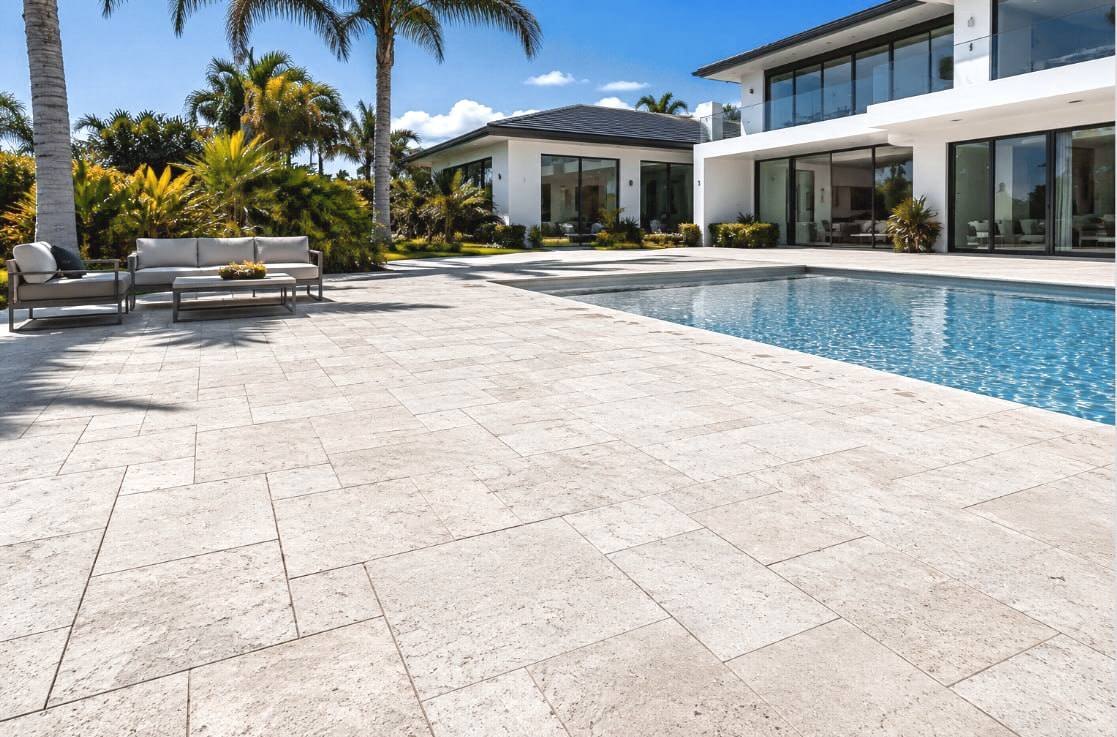
If you are choosing pool deck pavers in Broward or Palm Beach County, the decision is different here than almost anywhere else. Our sun is intense, our rain comes in sheets, and the surface around a pool lives in constant contact with salt or chlorine. A material that looks great in a national catalog can still cook your feet at noon or get slick when it is wet. This guide walks through how to pick pool deck pavers for South Florida conditions specifically, so you go into your project knowing what matters most.
How to choose pool deck pavers for South Florida heat and slip
The single most useful thing to understand about pool deck pavers is that barefoot heat and wet grip depend more on color, finish, and texture than on the base material itself. Daltile, a major manufacturer, publishes a Solar Reflectance Index (SRI) for its outdoor porcelain that makes this clear: a higher SRI number means a cooler surface in the sun.
Within a single Daltile porcelain line (TREAD 2CM), the spread is dramatic. A dark Bluestone-look color carries an SRI of about 23.55 and a Voyager Black around 31, while a Luminary White reaches 65 and a Studio Carrara about 65.45, with mid-tones like Editorial Volakas at 57 and Jet Setter Dusk at 47 falling in between. That is the same material, same line, with the cooler colors reflecting more than twice the heat of the darkest ones.
According to Daltile’s own data, dark grey, black, and brown porcelain run roughly 10 to 22 percent hotter, while white, cream, and light grey absorb and retain 5 to 20 percent less heat than concrete. The practical takeaway is one most South Florida homeowners do not expect: light-colored surfaces stay cooler underfoot than dark ones across all of these materials, so a light concrete paver can run cooler than a dark porcelain. If bare feet on a hot deck is your concern, choose by color first.
One thing to be honest about: published SRI numbers exist mainly per porcelain brand and color. We did not find a generic published SRI for travertine, shellstone, or unbranded concrete pavers, so the cleanest apples-to-apples heat comparison available is within porcelain lines. The general color principle still holds, but be wary of anyone quoting a precise “degrees cooler” figure for natural stone without a spec sheet behind it.
Slip resistance: what the wet numbers mean
Around a pool, the surface is wet by definition, so wet slip resistance is not optional. The relevant measured standard is ANSI A326.3, which reports a wet Dynamic Coefficient of Friction (DCOF). For a level interior surface walked on when wet, the published minimum is 0.42. For clean, maintained outdoor wet areas, the figure cited is 0.55. Higher is grippier.
Here is the catch for buyers: DCOF is product-specific. We did not find a published wet DCOF for travertine, shellstone, or generic concrete pavers in our sources, because the number lives on individual brand spec sheets, not on the material category as a whole. So when you compare options, ask the supplier for the actual DCOF of the specific product and finish you are considering, and look for an outdoor-rated, high-grip finish. Some manufacturer spec pages also reference an R11 slip class for outdoor wet use; treat that as a manufacturer claim and confirm it on the spec sheet for your exact product.
Finish matters as much as the rating. Installers report that tumbled or textured travertine has good wet grip, while smooth or polished finishes are riskier when wet. If you love a polished look, that is a real safety trade-off to weigh near the water.
Material by material, framed for South Florida
Here is how the three common choices compare for porcelain, travertine and other natural stone, and concrete, on the factors that matter most by the water:
| Material | Barefoot heat | Wet grip | Salt & chlorine | Sealing |
|---|---|---|---|---|
| Porcelain | Coolest in light colors (measured SRI) | Finish-dependent, pick a high-grip outdoor finish | Non-porous, chemical resistant | None needed |
| Travertine & shellstone | Cooler in lighter tones; no published SRI | Good when tumbled or textured, riskier polished | Porous, sensitive to pool chemistry | Periodic sealing |
| Concrete pavers | More heat, especially in dark colors | Finish-dependent, ask for the DCOF | Prone to staining and fading | Seal to protect color |
A note on that table: the heat ranking for porcelain is measured (Daltile SRI), while the grip, staining, and sealing entries are installer guidance and depend on the exact product and finish, so always confirm the wet DCOF on the specific spec sheet. The concrete heat and staining points lean on a Southern California installer source, so treat them as general rather than a Florida-specific measurement.
Homeowners weigh these the same way. On a homeowner forum, one person preferred porcelain because it does not get hot and is not slippery, while another warned that travertine gets hot, stains, and needs a lot of maintenance. On another thread, a homeowner favored pavers over a poured slab, saying they look nicer, feel cooler, and are easier to repair. These are individual opinions rather than measurements, but they line up with the trade-offs above.
Salt, chlorine, and sealing in our humidity
The water chemistry around a South Florida pool is hard on porous surfaces, which is what makes sealing a natural-stone deck a recurring task rather than a one-time step. Sealing protects the color and helps the stone resist staining from pool chemistry, and our humidity is a factor in how often it needs redoing. Porcelain sidesteps most of this because installers describe it as non-porous and chemical resistant, needing no sealing at all. None of this means natural stone is a wrong choice; it means you should pick it knowing the upkeep, rather than being surprised by it a year in.
This is also where finish and grip intersect with maintenance. A textured travertine finish that grips well when wet is also the finish most exposed to grime in our climate, so a realistic cleaning and resealing routine keeps both the look and the safety intact. When you compare quotes, ask each installer to spell out the sealing and cleaning interval they recommend for the exact product, so you are comparing total ownership and not just the first install.
Permits in Broward and Palm Beach: expect city-by-city rules
A point that surprises many homeowners: in South Florida, pool deck and patio permits are issued at the city level, and the county handles only unincorporated areas, per Palm Beach County’s owner-builder guidelines. There is no single county-wide pool-deck permit or HOA rule set; requirements are city-specific.
You can see this in how individual cities publish their own materials. Coral Springs publishes a city building-department checklist for pool deck, patio, and slab permits, and the Palm Beach Gardens building division provides a permit documentation page covering pool and deck work. The honest summary is that you will need to check your specific city’s building department, not a single regional rulebook. A reputable installer will handle this for you and pull the correct permit for your municipality.
If you live in an HOA, factor it in early. Under Florida’s HOA Act, associations can regulate exterior and hardscape changes, and many South Florida communities require architectural-review approval before you change pool deck material. The specifics live in your community’s own governing documents, so check your CC&Rs or ask your association before you order anything.
Bringing it together
For a South Florida pool deck, the smartest path is to choose by performance in our climate, in this order: pick a light color to keep the surface cool underfoot, confirm a real wet DCOF and an outdoor high-grip finish for safety near the water, and match the material’s maintenance to your tolerance for sealing against salt and chlorine. Porcelain leans low-maintenance, travertine and shellstone offer the natural look at the cost of periodic sealing, and concrete pavers can work well in lighter colors with regular upkeep.
If you want to walk your specific yard, sun exposure, and city’s permit requirements with someone who installs these surfaces every week, see our pool deck services or browse finished projects in our portfolio.